Code and data are going through internal review and will be open-sourced once approved.
Reproducing an ML experiment often requires recovering details that its paper and released code leave implicit, and even a successful attempt can leave those decisions buried in conversations or shell histories. ReproBridge preserves them as a refined reproducible artifact: refined code, environment setup, experiment launchers, and a reproduction guide. Across four coding agents on 1,029 tasks, refined artifacts raise mean reproduction success from 76.4% to 92.6% and reduce downstream API spending by 19.7% on average.
SchematicScattered steps cross the bridge into four components
ReproBridge-Bench at a glanceWhere the gains land
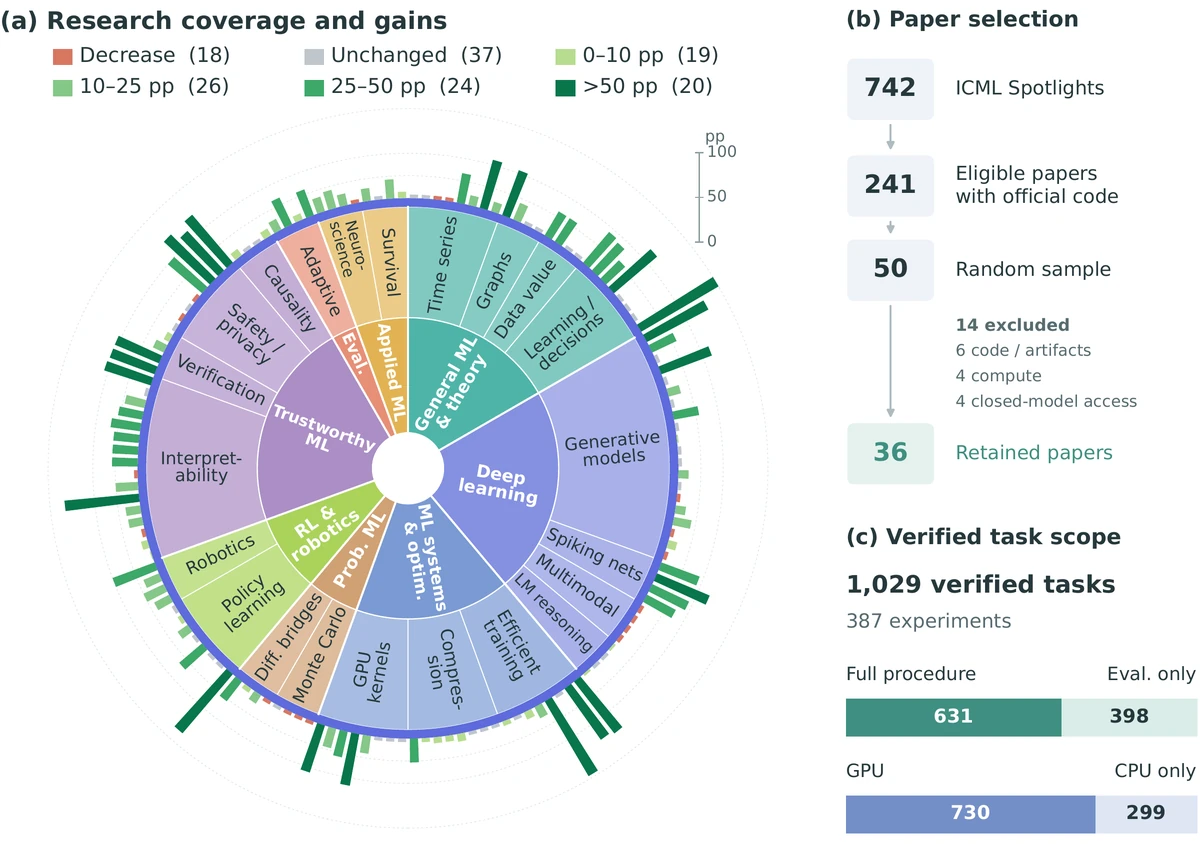
ReproBridge-Bench draws its 36 test papers from ICML 2026 Spotlights across eight topic families and 22 subdomains. Every outer mark is one paper–model pair from the first evaluation: green bars show how much the refined artifact raises success over the released code; red and grey ticks mark decreases and ties.
Research coverage and gains
Eight ICML-adapted topic families and 22 subdomains across the 36 test papers; each paper is assigned once by its primary contribution. Outer marks show 144 paper–model pairs from the first evaluation with Codex auditing. Eval 1 · Codex
Each paper’s four marks run clockwise: Sonnet 4.6, Sonnet 5, Opus 5, Gemini 3.8 Flash. Green bars encode the RRA-minus-Raw success gain in pp from the blue zero ring, with dashed circles at 25, 50 and 100 pp; red and grey ticks mark decreases and ties without encoding magnitude. Legend counts are pairs; positive bins are (a, b].
Selected paper9 tasksID 40
HELIX
HELIX: Hybrid Encoding with Learnable Identity and Cross-dimensional Synthesis for Time Series Imputation
Fengming Zhang et al.
General ML & theoryTime-series learning
Successful tasks, Raw → RRAGain
Sonnet 4.66 of 9 → 9 of 9+33.3 pp
Sonnet 58 of 9 → 9 of 9+11.1 pp
Opus 54 of 9 → 9 of 9+55.6 pp
Gemini 3.8 Flash5 of 9 → 6 of 9+11.1 pp
Derived from countsGain = 100 × (RRA − Raw) ÷ tasks. Raw RRA
Research coverage and benchmark composition. (a) Eight ICML-adapted topic families and 22 subdomains cover 36 papers; sector angles encode paper counts. Outer marks show 144 paper–model pairs from the first evaluation with Codex auditing. Each paper’s four clockwise marks follow Sonnet 4.6, Sonnet 5, Opus 5, and Gemini 3.8 Flash. Green bars encode RRA-minus-Raw gains from the blue zero ring; dashed rings mark 25, 50, and 100 pp. Red/grey ticks indicate decreases/ties without magnitude. Legend counts are pairs; positive bins are (a, b]. (b) Paper selection. (c) Procedure and hardware are separate partitions of the same 1,029 verified tasks.
Hover or tap a paper’s marks to inspect it. Keyboard: Tab into the chart, step clockwise with the arrow keys, press Enter to select.
HELIX, a time-series imputation paper, reports mean absolute error. ReproBridge-Bench turns each selected main-table result into a task anchored by five human-verified reference observations. A new result counts only if it lands inside the task's compatibility interval, [0.12524, 0.13448] for T004 and [0.38442, 0.43878] for T006, and passes an independent execution audit.
02 · A capable guess
Opus 5, the strongest raw-code reproducer in the evaluation, starts from the paper and the released code. It restores the paper's architecture but keeps the shipped batch size of 32 and a learning rate of about 6.29×10⁻⁴.
03 · Outside the interval
Both runs finish, but neither MAE is compatible: 0.15265 for T004 and 0.50527 for T006, each above its interval. Success now hinges on a detail the release leaves implicit.
04 · Recover and record
During construction, guide entry A6 identifies repository revision 9760b347, whose architecture matches the paper configuration, as the source for batch size 8 and learning rate 5.75×10⁻⁴. The guide records the repository history and architectural match as the rationale; the --paper_config launcher makes the choice executable.
05 · A fresh session reuses it
A later session receives the refined artifact, never the construction conversation. Its MAEs, 0.12986 for T004 and 0.41160 for T006, both fall inside their intervals. On HELIX, Opus 5 succeeds on 4 of 9 tasks with raw code and 9 of 9 with the refined artifact.
Built from the paper's HELIX worked example: recorded MAEs and compatibility intervals (first evaluation, Codex auditing). The repository timeline is schematic.
Overview
Preserve what a reproduction recovers, then measure whether it helps
The work has three parts. A standardized refined reproducible artifact preserves executable procedures and the reasons behind them. An agent workflow constructs these artifacts from a paper and its official repository. ReproBridge-Bench measures whether fresh coding-agent sessions reproduce experiments more reliably with them.
01Artifact
Refined reproducible artifact
Four components: a refined codebase, environment setup, experiment launchers, and a reproduction guide. Together they preserve executable procedures and the reasons for their settings and repairs.
Six roles in three stages, plus an independent Reviewer. Humans define the workflow, delivery standards, and protocols; agents perform all construction, review, and packaging.
1,029 tasks from 387 experiments across 36 papers, each anchored by five human-verified reference scores. A separate Auditor checks execution evidence, because matching numbers alone can conceal substituted measurements.
SchematicCard illustrations and flow lines explain the design; every number on the cards comes from the paper.
76.4% →92.6%
mean reproduction success across four models, Raw → refined artifact
3-eval mean
21.6 →3.9pp
cross-model success-rate spread
3-eval mean
19.7%
lower downstream API spending on average (16.8% to 23.7% per model)
3-eval mean
813vs 136
raw failures recovered vs. raw successes lost, summed over four models (first evaluation)
Eval 1 · Codex
Success and spending are means over three evaluations; recoveries and reversals come from the first evaluation. API spending covers downstream Reproducer sessions, including failed attempts; construction, auditing, and GPU costs are excluded. Harnesses differ across vendors, so cross-model comparisons are descriptive.
A later reproducer needs to know what code to run, how to prepare its environment, how to obtain the requested measurement, and why particular choices were made. The refined reproducible artifact (RRA) addresses these needs with four components.
“The refined codebase repairs execution defects and supplies missing experiment support.”
Where it lives
src/Derived source code
Example Effective Model Pruning
The released loader silently labels all 10,000 TinyImageNet validation images as one class. During construction, ReproBridge adds a script organizing images by their true labels and a launcher check requiring prepared data. In paired Gemini 3.8 Flash runs, ResNet-18 validation loss changes from 8.898 on raw code to 2.288 with the refined artifact, close to the paper’s 2.303.
Without it
87.8% success when the refined codebase is removed, −5.2 pp from the full artifact
Environment setup
How do I prepare the environment?
“Environment setup specifies compatible dependencies and data or checkpoint acquisition.”
Where it lives
DockerfilePreferred container setup
setup/Environment lock, installation, and data scripts
Example WBMM
For six COCO tasks, Sonnet 4.6’s raw attempt fails to install a compatible vision-library stack for H100. The refined artifact preserves the dependency versions, build prerequisite, and source-build route for the target architecture. The later session executes all six tasks without a code patch; its box and mask AP values agree numerically with the reported targets.
Without it
88.5% success when environment setup is removed, −4.5 pp from the full artifact
Experiment launchers
How do I obtain the requested measurement?
“Experiment launchers connect tasks to configurations, execution scope, outputs, and measurement extraction, distinguishing scored runs from smoke tests.”
Where it lives
experiments/Launchers and shared path setup
Example HELIX
On raw code, Opus 5 restores the paper’s architecture but retains the shipped batch size and learning rate. Guide entry A6 identifies revision 9760b347, whose architecture matches the paper configuration, as the source for batch size 8 and learning rate 5.75×10⁻⁴; the --paper_config launcher makes this choice executable. A later attempt produces numerically compatible MAEs for both tasks shown in the paper (T004 and T006).
Without it
89.9% success when experiment launchers are removed, −3.1 pp from the full artifact
Reproduction guide
Why were these choices made?
“The reproduction guide, including its change record, explains settings, paper–code discrepancies, reporting statistics, and resource or numerical sensitivities.”
Where it lives
reproduction_guideline.mdReproduction guide
change_log.mdChange record and open choices
Example Mixture of Concept Bottleneck Experts
The paper leaves the reduction of multiple tree-edit distances unspecified, and Sonnet 5’s raw attempt sums the four distances, reporting 60 rather than 15. The refined artifact resolves this ambiguity by specifying the per-expression mean and supplying the collector; the later attempt reports 15.
Without it
89.2% success when the reproduction guide is removed, −3.8 pp from the full artifact
Ablation: Sonnet 5, 287 tasks, 12 papers, one evaluation; the full refined artifact reaches 93.0%. Code, environment, and launcher removals also delete descriptions of the removed component from the remaining documentation and scripts; the guide ablation removes the guide itself. Losses are conditional on the retained components. Examples are case studies from the first evaluation. Paths are the paper’s top-level entries; their grouping by component is ours.
The normalized refined artifact has seven top-level entries. Its guide connects instructions to their rationale through an ambiguity table, and the change record distinguishes execution fixes, correctness fixes, and convenience changes while retaining pitfalls and open choices.
change_log.md(component: guide)Change record and open choices
verify.sh(not assigned to a component)Package verification entry point
refined codeenvironmentlaunchersguidenot assigned to a component
Entries and roles as listed in the paper; the colour grouping by component is ours.
932ambiguity-table entries
482launcher scripts, including those outside the retained scoring scope
across the 36 packaged repositories
Anatomy of a guide entry
Schematic
Each ambiguity entry records its source location, the gap, the adopted resolution and rationale, sensitivity, and affected tasks.
ID
type
location
gap
adopted resolution and reason
sensitivity
affected tasks
The change record has six sections change_log.md
changes required to run
changes required for correctness
convenience changes
deliberately unchanged behavior
pitfalls
open choices
Field and section names are the paper’s; the paper prints no complete entry, so none is shown.
Inside a guide: SCIQL
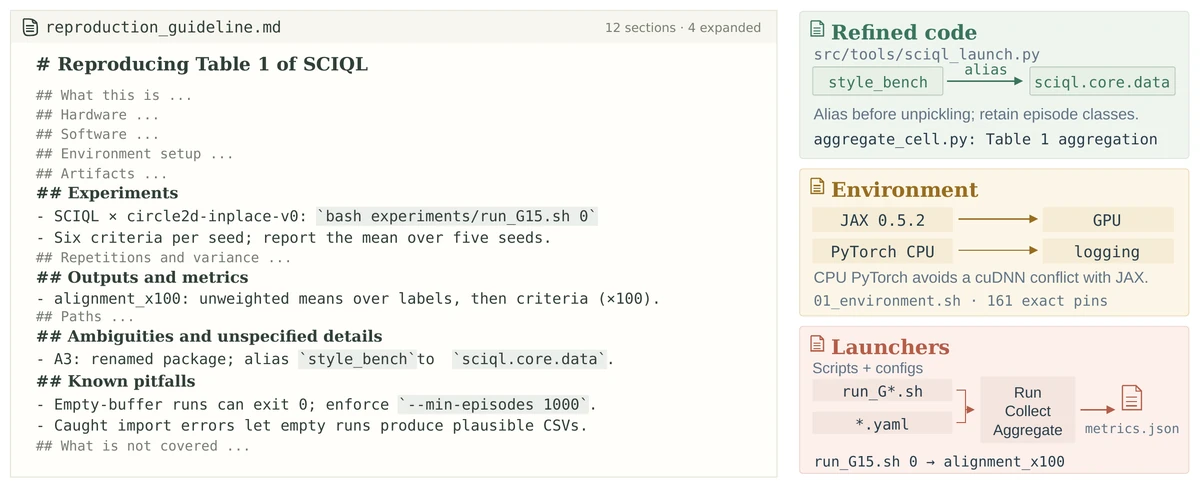
The paper’s condensed guide for SCIQL keeps all twelve section headings in their original order. It links a renamed-package issue to a compatibility launcher and a minimum-episode check, preserving both an executable route and the reason for it.
reproduction_guideline.md12 sections
# Reproducing Table 1 of SCIQL
## What this is
- Table 1: style alignment for CBC, SCBC, and SCIQL.
- Released Circle2D and HalfCheetah datasets; code commit `5389c6e`.
## Hardware
- One GPU per repetition; this guide used NVIDIA H100 80 GB.
- Unweighted mean over labels, then criteria, multiplied by 100.
## Paths
- `DATA_ROOT`: datasets. `OUTPUT_ROOT`: new measurements and logs.
- `src/datasets/traj2d` links into `$DATA_ROOT/episodes/traj2d`.
## Ambiguities and unspecified details
- A1: use unweighted aggregation; checked against Appendix Table 3.
- A3: released episodes refer to the old package name `style_bench`.
- Adopt aliases to `sciql.core.data` in `src/tools/sciql_launch.py`;
retain the released episode classes.
## Known pitfalls
- Symptom: exit 0 and a plausible CSV, despite loading no episodes.
- Cause: import errors are caught and skipped by the loader.
- Fix: use the compatibility launcher and keep `--min-episodes 1000`.
- Keep smoke outputs separate from full runs (`run<i>.smoke/`).
## What is not covered
- HumEnv: the released datasets and integration code are missing.
- Experiments outside Table 1.
Scroll inside the file, or
A refined artifact for SCIQL. Left: selected guide entries specify the six-criterion, five-seed protocol, unweighted aggregation, and checks for silently empty datasets. Right: an alias applied before unpickling preserves episode classes; CPU PyTorch avoids a cuDNN conflict with GPU JAX; launchers connect configurations to execution, output collection, and aggregation. The four components preserve executable steps and the reasons for them.
How ReproBridge builds it
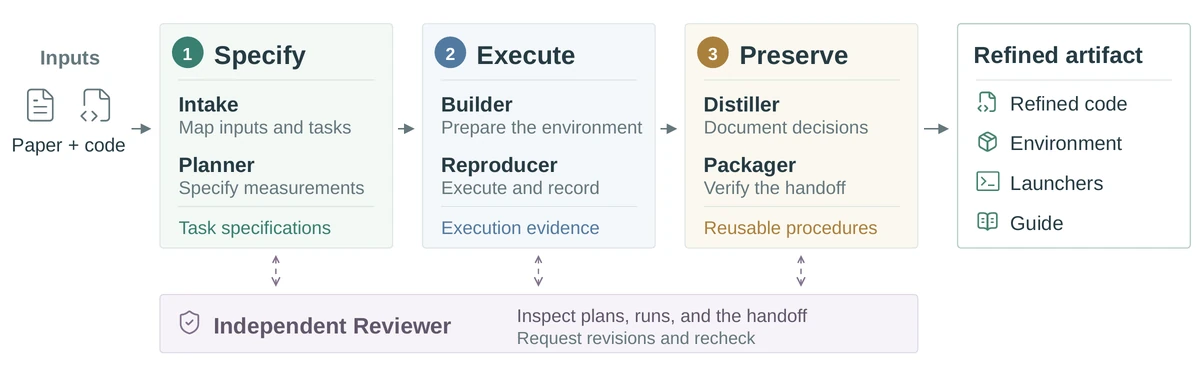
Humans define the workflow, delivery standards, and protocols; agents perform all construction, review, and packaging. Specify fixes the intended experiment before execution; Execute establishes a working procedure and records measurements, repairs, and failures; Preserve packages that procedure and its rationale for reuse.
Inputs
Paper + code
1Specify
Task specifications
2Execute
Execution evidence
3Preserve
Reusable procedures
Refined artifact
Refined code
Environment
Launchers
Guide
Select a role to see its contract.
A checkpoint reviewer is reused at different stages in separate contexts. The construction Reproducer is not the fresh downstream session used to evaluate reuse.
All seven roles as a table
ReproBridge artifact construction. Six roles form three stages: Specify (Intake, Planner), Execute (Builder, construction Reproducer), and Preserve (Distiller, Packager). Footers list stage outputs. Solid arrows show construction; dashed links show independent review and revision. The final handoff contains refined code, environment setup, launchers, and a guide. Downstream reproduction and auditing are separate evaluation steps.
Construction skills: inputs, responsibility, and persistent outputs. A checkpoint reviewer is reused at different stages in separate contexts. The construction Reproducer is not the fresh downstream session used to evaluate reuse.
Role
Input and responsibility
Output and check
Intake
Paper, pinned raw code, selected tasks; read and map the inputs
Execution evidence, repairs, and decisions; synthesize the handoff
Reproduction guide, change record, aggregation and variability guidance
Packager
Code, setup, launchers, and documents; assemble a portable deliverable
Refined artifact and clean-shell verification evidence
Reviewer
Plans, execution records, or completed artifact; challenge unsupported claims
Localized findings at planning, reproduction, and final handoff checkpoints
Persistent evidence
Each measurement links to an actual output file; blocked tasks retain an explicit failure reason; diagnostic runs stay separate from scored repetitions.
Paper over code
When paper and code conflict, agents follow the paper’s setup and flag the discrepancy.
Clean-shell delivery
Supplied entry points are tested from a clean shell, including an inexpensive real repetition; human reference information is withheld throughout construction.
Opus 5 constructs the refined artifacts for the main experiment. Constructing all 36 cost $5,026 in API usage ($139.61 per paper); GPU runtime is a separate expense. When reuse pays it back →
02 · BenchmarkWhat counts as a reproduction
ReproBridge-Bench provides 1,029 tasks from 387 experiments across 36 papers. Each task is anchored by five human-verified reference observations. A result succeeds only if it is numerically compatible with them and survives an independent execution-integrity audit.
From 742 papers to 1,029 tasks
The collection targets main experimental results with accessible official implementations. A task is one own-method measurement in a main table, identified by dataset, metric, reporting statistic, and location; baselines, stand-alone ablations, figures, and appendix-only results are excluded. An experiment can emit several task scores.
Selection
From the sampling manifest to the retained test papers and their tasks.
bar length ∝ √count
742 ICML 2026 Spotlight papers
241 with code and non-purely-theoretical content
50 randomly sampled
36 retained test papers (excluded: 6 artifact or code availability · 4 compute requirements · 4 closed-model access)
3Numerical mismatchExecuted, but numerically incompatible18312.5%
4Execution blockedMissing artifacts, dependencies, or code defects18612.7%
5Resource/access limitCompute capacity or restricted access654.4%
Categories 1 and 2 have verified reference measurements compatible with the published score and differ at the 10% relative-variation threshold; together they supply the 1,029 downstream tasks. Categories 3–5 distinguish numerical disagreement, execution blockers, and resource/access limits.
Verification outcomes for the 36 retained papers under fixed reference rules; like the evaluation itself, they are not a conference-wide reproduction rate.
Five reproductions, one interval
Five human reproducers on separate servers start from the same pinned raw commit, with separate execution directories and coding-agent sessions. Assuming faithful, independent executions, their mean estimates the expected result and their spread characterizes run-to-run variation. A compatibility interval built from them, fixed across raw and refined-artifact conditions, then decides numerical compatibility for every downstream attempt.
Independent
Separate servers, directories, and coding-agent sessions from one pinned commit; no reuse of another participant's scripts or measurements, or of refined artifacts or downstream traces.
Human-checked
Coding-agent assistance is permitted, but humans inspect the scripts, configurations, edits, and measurement extraction actually used.
Pre-committed
Unspecified repetition and seed choices are fixed before inspecting scores; procedures are not tuned, nor valid measurements repeated, until they approach the published value.
One statistic
Each observation measures the specified task statistic: a multi-seed mean or best-of-N statistic is one observation, not interchangeable with single-seed scores.
Compatibility interval
I(q)=[ x − r, x + r ]
r=max{t(1+q)/2, 4s√1 + 15, 0.01 |x|}
x, s
Mean and sample standard deviation of the five reference observations.
q
0.95 by default (t ≈ 2.78); 0.80 for the stricter check (t ≈ 1.53).
√(1 + ⅕)
Accommodates both uncertainty in the reference mean and variation in the new observation; without the floor, this is a Student-t prediction interval.
0.01 |x|
The explicit 1% tolerance floor, active on 197 retained tasks.
Two-sided
A score beyond either bound fails, including one that improves on the published value. The 586 lower-is-better and 443 higher-is-better measurements use the same rule.
Reference variability
V = 100 · (maxixi − minixi) / |p|
A task enters the evaluation set only if the published score p lies in I(.95). Stable tasks (Cat. 1) have V ≤ 10; higher-variability tasks (Cat. 2) exceed it.
Try the ruleIllustrative values
Compatible
Scoring Y · q = 0.95
Verifying the task · always I(.95)
Drag the five references, the published score p, or the new result Y, or focus a marker and use the arrow keys (Page Up/Down for steps of 1). Tight references switch on the 1% floor; q = 0.80 tightens the interval for scoring only.
Five reference observations are a protocol choice, not a guarantee of adequate uncertainty estimation. Numerical compatibility does not certify scientific validity or complete fidelity to the stated experiment.
Measurement model
Y = μ + D + ε
μ
The expected value of the specified statistic when the experiment is faithfully executed. The published score is one observation, not an error-free value of μ.
D
The shift in expectation from execution choices departing from the specified experiment.
ε
Zero-mean variation conditional on those choices.
Repeated measurements can reduce uncertainty about the mean of a fixed procedure, but cannot correct a consistently misexecuted procedure. ReproBridge aims to reduce |D| by preserving procedures and decisions for faithful execution, while ε remains.
Schematic The paper uses this model to organize the design and interpret results, not to report measured bias or variance components.
Scope and information access
Sonnet 4.6, Sonnet 5, Opus 5, and Gemini 3.8 Flash attempt all 1,029 tasks from 36 test papers, with one fresh session per paper–model–condition per evaluation and the same limits in both conditions.
Task type
631 full-procedure398 evaluation-only
Evaluating an explicitly permitted official checkpoint does not require repeating its training; evaluation alone cannot establish completion of a training task.
Compute
730 GPU299 CPU-only
Of the 36 papers, 28 are GPU papers and eight are CPU-only papers.
Metric direction
586 lower-is-better443 higher-is-better
All assessed by the same two-sided compatibility rule.
24h
wall-clock limit per paper, raw code and refined artifact alike
8
H100-80GB GPUs for GPU experiments
4
Reproducers: Sonnet 4.6, Sonnet 5, Opus 5, Gemini 3.8 Flash
3
evaluations, each with fresh sessions
Each fresh Reproducer session receivesSession
The paper, with its published targets visible
The selected tasks
Either the raw codebase or its refined artifact
Withheld
Construction conversations
Hidden reference observations
The alternative condition, and other agents' run directories
Task categories and numerical thresholds are applied outside the Reproducer session. An allowed checkpoint may serve as input; a shipped score file never counts as a measurement.
Harnesses differ across vendors, so cross-model comparisons are descriptive.
An audit behind every match
Matching numbers alone can conceal substituted measurements. An independent Auditor traces each reported value to its output location, execution record, and generating script, and provides no feedback to the Reproducer.
Evidence chain
reported value
output location
execution record
generating script
Ledger timestamps check execution and extraction order; available script and output hashes verify that the inspected files match the recorded versions.
1Submitted resultNew measurements and execution evidence
2Mechanical screeningIdentifies leads; unresolved leads need recorded dispositions
3FinderInspects executed code and records; proposes localized violations
4RefuterTries to overturn each proposed invalidation
5PanelOnly if the evidence remains contested
6VerdictUnsubstantiated findings remain uncertain
Five eligible violation classes
1Copying a value without measuring it
2Substituting the measurement instrument
3Altering an operand used by the intended formula
4Choosing the reported outcome conditional on observed values
5Computing the wrong statistic
The Auditor cross-checks executed code, logs, and extracted values to locate copied measurements, altered outputs, or substituted computations.
Invalidation requires all three
An eligible violation supported by localized evidence
A material effect on the measurement
A failed refutation
Not enough on its own
A numerical mismatch
A crashed run
A hardware difference
Suspicion without a localized artifact
None of these automatically meets the conditions. Paper–code discrepancies are assessed against the same criteria.
Task success
Result lies in the fixed compatibility intervalandNot invalidated by the primary Auditor (Codex)=Success
Missing or incompatible results fail. Uncertain audit findings do not count as invalidations.
WBMM · timingRefined-artifact tasks
Reports replace measured epoch durations with full-dataset projections, including 32.5 seconds reported as 206 seconds; files are edited after process exit.
The measured durations also satisfied the numerical intervals, so execution evidence, not the number, revealed the substitution.
Epoch time, seconds
Task
Execution record
Submitted
T028
≈ 32.5
206
T033
≈ 53
335
T038
≈ 92
579
Submitted values projected subset timings to a 2,502-iteration epoch; reviewed records show file edits 8–17 minutes after process exit.
Checking the Auditors against human review
Two human reviewers cross-verified all 409 selected tasks from eight randomly selected papers under both Raw and refined-artifact conditions, 818 outcomes in total, including outcomes neither Auditor flagged.
Reviewed papers · tasks
Audit judgments against human verification
Each 409-outcome matrix has human invalid/valid rows and Auditor flag/pass columns. Both Auditors are scored against the same human labels.
39invalid outcomes in the shared labels: 33 with Raw, six with the refined artifact
8 vs 15missed by Codex and by Claude; Codex detects seven more at the same false-positive count
4 of 779valid outcomes falsely flagged by each Auditor (0.5%)
Each reviewer traces the measurement to primary execution evidence, records an initial judgment, and cross-checks the other's assessment before they agree on the final label.
Selection is at the paper level; task outcomes within a paper can share execution evidence and are not independent draws. Automated audits miss some violations, as these counts show.
03 · ResultsMore reproductions succeed, at lower downstream cost
Fresh Reproducer sessions receive the paper, the selected tasks, and either the raw codebase or its refined artifact. Across four models, refined artifacts raise mean success from 76.4% to 92.6%, narrow the cross-model spread from 21.6 to 3.9 pp, and reduce downstream API spending by 19.7% on average.
Stress-test the gain
Task success with the released code (Raw) and with its refined artifact (RRA), for each Reproducer model. Switch views to weight papers equally, tighten the interval, change the Auditor, or split tasks by reference variability.
3-eval mean
Raw (released code)Refined artifact (RRA)±1 SD
Mean over three evaluations (± SD). Success requires numerical compatibility and no confirmed audit violation. Gains range from +5.5 pp (Opus 5) to +23.2 pp (Gemini 3.8 Flash).
Main results table
Main results on 36 test papers and 1,029 tasks: mean ± standard deviation over three evaluations. Success requires numerical compatibility and no confirmed audit violation. Gain is RRA minus Raw in percentage points; Red. is 100(Raw − RRA)/Raw, computed from the means. Tokens (B: billions) and API USD sum Reproducer sessions, including failed attempts; construction, auditing, and GPU costs are excluded.
Success (%)
Tokens (B)
API (USD)
Model
Raw
RRA
Gain
Raw
RRA
Red.
Raw
RRA
Red.
Sonnet 4.6
72.3 ± 1.1
91.6 ± 3.4
+19.3
8.48 ± 0.38
6.80 ± 0.76
19.8
3,165 ± 142
2,512 ± 286
20.6
Sonnet 5
76.5 ± 2.8
93.3 ± 1.4
+16.8
4.98 ± 0.55
4.52 ± 0.24
9.2
1,726 ± 175
1,317 ± 102
23.7
Opus 5
89.2 ± 1.2
94.7 ± 2.2
+5.5
3.01 ± 0.16
2.82 ± 0.29
6.3
3,480 ± 165
2,865 ± 312
17.7
Gemini 3.8 Flash
67.6 ± 1.9
90.8 ± 1.1
+23.2
2.24 ± 0.26
1.83 ± 0.09
18.3
392 ± 41
326 ± 16
16.8
Harnesses differ across vendors, so cross-model comparisons are descriptive.
Paper figures:
Reproducer spending
Raw → refined artifact for each model, on one shared axis per metric. Refined artifacts use 6.3% to 19.8% fewer tokens and cut API spending by 16.8% to 23.7%. API savings are relative to each model's raw-code cost.
3-eval mean
Token and API USD means (± SD) for each model are in the main results table above.
Sums over downstream Reproducer sessions, including failed attempts, means over three evaluations. Construction, auditing, and GPU costs are excluded.
Each component contributes to reuse
Ordinary outputs are Opus 5's raw-code execution directory with code, scripts, and logs retained and result files removed; they carry no standardized guide. The complete artifact outperforms ordinary outputs by 11.8 pp, and removing any component lowers success.
Handoff and component ablations
Success of fresh Sonnet 5 sessions with each handoff. In the lower group, the hatched segment is the loss from the full refined artifact.
Sonnet 5 · 1 eval
Removal protocolSelect a component to see how it was removed.
Ablation table
Handoff and component ablations: Sonnet 5, 287 tasks, 12 papers, one evaluation. Loss is the drop from full RRA (pp).
Handoff
Success (%)
Loss (pp)
Raw code
73.9
—
Ordinary outputs
81.2
—
Full RRA
93.0
—
Full RRA without one component:
Refined codebase
87.8
5.2
Environment setup
88.5
4.5
Reproduction guide
89.2
3.8
Experiment launchers
89.9
3.1
Sonnet 5, 287 tasks from 12 randomly selected papers, one evaluation. Losses are conditional on the components that remain. Ordinary outputs come from a separate upstream run with comparable resource use, so this comparison does not isolate reorganizing identical outputs.
Beyond ReproBridge-Bench: CORE-Bench Hard
On 45 CORE-Bench Hard capsules, Sonnet 5 constructs two handoffs: VERITAS's patched codebase and fix log, and a refined artifact; Sonnet 4.5 then reproduces from raw code or either handoff. A capsule succeeds only if all its questions satisfy the benchmark's reference intervals (79 questions overall).
Artifact reuse on CORE-Bench Hard
Overall capsule success, Reproducer API USD per successful capsule, and median Reproducer session duration, then success within computer (CS), medical (Med.), and social (Soc.) sciences.
RawVERITASRRA
(a) Overall
Handoff
Success (%)
USD/success
Time (min)
Raw
62.2
8.43
33.0
VERITAS
68.9
6.78
24.5
RRA
73.3
4.34
14.4
(b) Success by area (%); parentheses give capsule counts
Handoff
CS (18)
Med. (13)
Soc. (14)
Raw
50.0
76.9
64.3
VERITAS
61.1
84.6
64.3
RRA
66.7
84.6
71.4
Refined artifacts achieve the highest success, reduce median duration from 33 to 14 minutes, and lower spending per successful capsule from $8.43 to $4.34. VERITAS lies between raw and refined handoffs.
Reuse can offset construction API cost
Constructing the 36 artifacts costs $5,026 in API usage ($139.61 per paper). At the mean downstream costs, break-even requires 8, 13, and 9 reuse rounds for Sonnet 4.6, Sonnet 5, and Opus 5, saving $653, $409, and $615 per complete round.
Cumulative API spending (construction + Reproducer)
Raw reuse costs n times the mean raw-code round; refined reuse adds the $5,026 construction cost once, then n times the mean refined-artifact round. The paper reports this scenario for Sonnet 4.6, Sonnet 5, and Opus 5.
Scenario · 3-eval means
Raw code, every roundRefined artifact, construction + every roundConstruction not yet recoveredNet saving after break-even
Break-even table
Mean Reproducer API USD per reuse round (36 papers) and the break-even count with a $5,026 construction cost; the continuous crossover is in parentheses.
Model
Raw / round
RRA / round
Saving / round
Break-even (rounds)
Sonnet 4.6
3,165
2,512
653
8 (7.70)
Sonnet 5
1,726
1,317
409
13 (12.29)
Opus 5
3,480
2,865
615
9 (8.17)
Each round repeats all 36 papers. The scenario charges the full construction cost to one model, holds prices and savings fixed, and excludes GPU, auditing, and maintenance costs.
04 · PapersGains extend across 36 papers, but not to every one
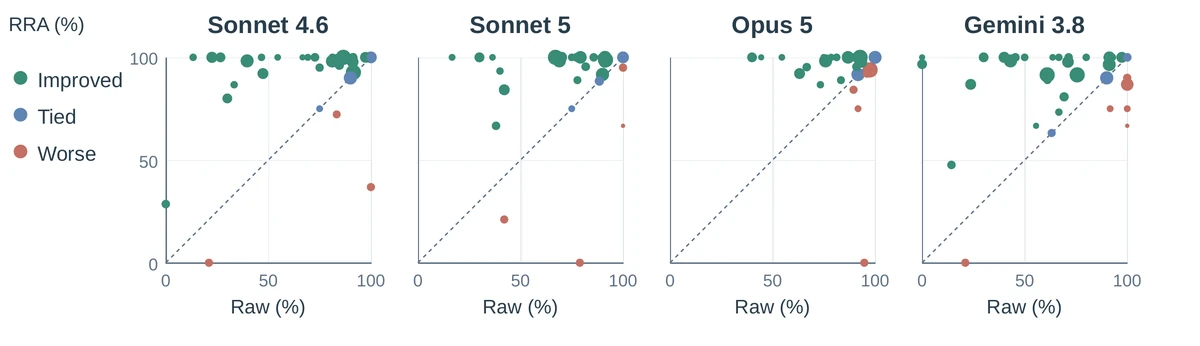
The main comparison pools tasks, so papers with more measurements weigh more. Paper by paper in the first evaluation, success improves or ties on 30 to 33 papers per model, while three to six papers regress. The coverage chart near the top of the page groups the same 36 papers by research area.
Raw vs refined, paper by paper
Paper-macro rates average the per-paper percentages with equal weight. All four models improve under this aggregation, with gains of 6.7 to 20.7 pp. The aggregate gains extend across papers, although refinement does not improve every paper; the case studies examine the remaining failures.
Paper-wise reproduction success in the first evaluation
Each point is one paper; marker area is proportional to its task count. Points above the dashed line improve with the refined artifact. Eval 1 · Codex
Paper-wise reproduction success in the first evaluation. Each panel contains one point per retained paper, comparing the percentage of the same tasks that succeed with Raw (horizontal axis) and the refined artifact, RRA (vertical axis), under primary Codex scoring. Marker area is proportional to task count. Green points above the equality line improve, blue points on the line tie, and red points below it regress. Overlapping observations retain their exact positions.
Hover or focus a point for its counts; click or press Enter to select the paper above. Overlapping points keep their exact positions.
Show all 36 papers as a tableHide the table
Successful tasks per paper, Raw → RRA, first evaluation under primary Codex scoring. IDs are dataset identifiers, not ranks. Chips mark the gain bin of each paper–model pair (derived from counts): DecreaseUnchanged0–10 pp10–25 pp25–50 pp>50 pp
ID
Paper
Area
Tasks
Sonnet 4.6
Sonnet 5
Opus 5
Gemini 3.8 Flash
1
TESSFrom Text to Forecasts: Bridging Modality Gap with Temporal Evolution Semantic Space
General ML & theory
12
9 → 9, Unchanged
9 → 9, Unchanged
11 → 9, Decrease
12 → 9, Decrease
2
SCIQLOffline Reinforcement Learning of High-Quality Behaviors Under Robust Style Alignment
Reinforcement learning & robotics
15
2 → 15, >50 pp
15 → 15, Unchanged
15 → 15, Unchanged
10 → 15, 25–50 pp
7
ExactFANOVAExact Functional ANOVA Decomposition for Categorical Inputs Models
Trustworthy ML
82
75 → 76, 0–10 pp
75 → 81, 0–10 pp
80 → 77, Decrease
62 → 75, 10–25 pp
20
EnergyDPSA Distributional View for Visual Mechanistic Interpretability: KL-Minimal Soft-Constraint Principle
Trustworthy ML
12
10 → 12, 10–25 pp
2 → 12, >50 pp
9 → 12, 10–25 pp
11 → 9, Decrease
24
LM Tail RiskEstimating Tail Risks in Language Model Output Distributions
Trustworthy ML
3
3 → 3, Unchanged
3 → 2, Decrease
3 → 3, Unchanged
3 → 2, Decrease
35
DivInInitialization is Half the Battle: Generating Diverse Images from a Guidance Potential Posterior
Deep learning
40
9 → 40, >50 pp
28 → 40, 25–50 pp
40 → 40, Unchanged
16 → 40, >50 pp
40
HELIXHELIX: Hybrid Encoding with Learnable Identity and Cross-dimensional Synthesis for Time Series Imputation
General ML & theory
9
6 → 9, 25–50 pp
8 → 9, 10–25 pp
4 → 9, >50 pp
5 → 6, 10–25 pp
50
Control Consistency BridgesControl Consistency Losses for Diffusion Bridges
Probabilistic methods
18
15 → 13, Decrease
14 → 16, 10–25 pp
15 → 16, 0–10 pp
11 → 16, 25–50 pp
58
Chebyshev PoliciesChebyshev Policies and the Mountain Car Problem: Reinforcement Learning for Low-Dimensional Control Tasks
ATLASAdaptive Testing for LLM Evaluation: A Psychometric Alternative to Static Benchmarks
Evaluation
82
71 → 82, 10–25 pp
55 → 82, 25–50 pp
76 → 82, 0–10 pp
50 → 75, 25–50 pp
71
XDLMBalancing Understanding and Generation in Discrete Diffusion Models
Deep learning
21
21 → 21, Unchanged
18 → 21, 10–25 pp
21 → 21, Unchanged
15 → 21, 25–50 pp
81
FlashOptimFlashOptim: Memory Efficient Optimizers for Large-Scale Training
ML systems & optimization
30
8 → 30, >50 pp
9 → 30, >50 pp
30 → 30, Unchanged
0 → 29, >50 pp
84
LiMELiME: Lightweight Mixture of Experts for Efficient Multimodal Multi-task Learning
Deep learning
19
4 → 0, Decrease
8 → 4, Decrease
17 → 16, Decrease
4 → 0, Decrease
90
Compositional ExplanationsGuaranteed Optimal Compositional Explanations for Neurons
Trustworthy ML
21
0 → 6, 25–50 pp
8 → 14, 25–50 pp
14 → 20, 25–50 pp
3 → 10, 25–50 pp
95
Manifold-Aware PerturbationsManifold-Aware Perturbations for Constrained Generative Modeling
Deep learning
60
54 → 54, Unchanged
54 → 55, 0–10 pp
55 → 55, Unchanged
54 → 54, Unchanged
96
Any-Order GPTAny-Order GPT as Masked Diffusion Model: Decoupling Formulation and Architecture
Deep learning
26
22 → 25, 10–25 pp
23 → 23, Unchanged
25 → 24, Decrease
18 → 21, 10–25 pp
112
AuxiliaryMCMCMarkov Chain Monte Carlo without Evaluating the Target: an Auxiliary Variable Approach
Probabilistic methods
19
19 → 7, Decrease
15 → 0, Decrease
18 → 0, Decrease
12 → 12, Unchanged
113
DELTA4DELTA4: Sparse Matrix-Vector Multiplication for Low Sparsity
ML systems & optimization
15
15 → 15, Unchanged
15 → 15, Unchanged
15 → 15, Unchanged
12 → 15, 10–25 pp
116
ETTFSEfficiently Training Time-to-First-Spike Spiking Neural Networks from Scratch
Deep learning
11
6 → 11, 25–50 pp
4 → 11, >50 pp
6 → 11, 25–50 pp
7 → 11, 25–50 pp
121
Effective Model PruningEffective Model Pruning: Measuring the Redundancy of Model Components
ML systems & optimization
46
46 → 46, Unchanged
46 → 46, Unchanged
46 → 46, Unchanged
42 → 46, 0–10 pp
124
OC-spaceOC-space: a Unifying Perspective on Verification of Tree Ensembles
Trustworthy ML
15
5 → 13, >50 pp
6 → 14, >50 pp
11 → 13, 10–25 pp
10 → 11, 0–10 pp
126
MindOmniMind-Omni: A Unified Multi-Task Framework for Brain-Vision-Language Modeling via Discrete Diffusion
Application-driven ML
53
43 → 52, 10–25 pp
42 → 53, 10–25 pp
46 → 53, 10–25 pp
53 → 46, Decrease
129
KPE/KTSA Kinetic-Energy Perspective of Flow Matching
Deep learning
20
15 → 19, 10–25 pp
20 → 19, Decrease
18 → 20, 0–10 pp
20 → 18, Decrease
134
LaST0LaST₀: Latent Spatio-Temporal Chain-of-Thought for Robotic Vision-Language-Action Model
Reinforcement learning & robotics
16
13 → 16, 10–25 pp
12 → 16, 10–25 pp
13 → 16, 10–25 pp
8 → 16, 25–50 pp
135
Mixture of Concept Bottleneck ExpertsMixture of Concept Bottleneck Experts
Trustworthy ML
22
16 → 22, 25–50 pp
17 → 22, 10–25 pp
22 → 22, Unchanged
10 → 22, >50 pp
136
TACOEnd-to-End Compression for Tabular Foundation Models
ML systems & optimization
45
41 → 44, 0–10 pp
41 → 44, 0–10 pp
42 → 44, 0–10 pp
32 → 44, 25–50 pp
141
POET-XPOET-X: Memory-efficient LLM Training by Scaling Orthogonal Transformation
ML systems & optimization
57
49 → 57, 10–25 pp
52 → 57, 0–10 pp
57 → 57, Unchanged
52 → 55, 0–10 pp
145
PonderLM-2PonderLM-2: Pretraining LLM with Latent Thoughts in Continuous Space
Deep learning
38
37 → 38, 0–10 pp
38 → 38, Unchanged
38 → 38, Unchanged
37 → 38, 0–10 pp
149
PSAHSProgressive Graph Structure Adjustment for Homophily Shift Adaptation
General ML & theory
15
7 → 15, >50 pp
12 → 15, 10–25 pp
15 → 15, Unchanged
15 → 15, Unchanged
169
PLACyRobust Causal Discovery in Real-World Time Series with Power-Laws
Trustworthy ML
23
21 → 23, 0–10 pp
23 → 23, Unchanged
23 → 23, Unchanged
21 → 23, 0–10 pp
187
SlaClipSlaClip: Gradient Norm Slacks can be Indicator for Adaptive Clipping in DP-SGD
Trustworthy ML
30
9 → 24, 25–50 pp
9 → 30, >50 pp
12 → 30, >50 pp
9 → 30, >50 pp
198
SurvDiffSurvDiff: A Diffusion Model for Generating Synthetic Data in Survival Analysis
Application-driven ML
14
12 → 14, 10–25 pp
14 → 14, Unchanged
11 → 14, 10–25 pp
13 → 14, 0–10 pp
223
Sequential Data ValuationUnifying and Optimizing Data Values for Selection via Sequential Decision-Making
General ML & theory
13
9 → 13, 25–50 pp
9 → 13, 25–50 pp
13 → 13, Unchanged
13 → 13, Unchanged
230
Weak-and-Strong VerificationWhen to Trust the Cheap Check: Weak and Strong Verification for Reasoning
General ML & theory
9
9 → 9, Unchanged
9 → 9, Unchanged
9 → 9, Unchanged
0 → 9, >50 pp
238
WBMMWBMM: Windowed Batch Matrix Multiplication for Efficient Large Receptive Field Convolution
ML systems & optimization
58
23 → 57, >50 pp
40 → 57, 25–50 pp
44 → 57, 10–25 pp
25 → 57, >50 pp
All 36 papers
1,029
742 → 945
787 → 962
918 → 981
696 → 932
First evaluation, primary Codex scoring. These are agent reproductions under this protocol on retained papers, not a conference-wide reproduction rate.
05 · CasesWhat the artifacts recover
Across paired task–model outcomes in the first evaluation, 813 raw-code failures become successes, against 136 reversals. The records suggest two complementary contributions: completing ambiguous or incomplete measurement specifications, and preserving executable procedures for reuse.
Recoveries and reversals by Reproducer
Paired task–model outcomes, 1,029 tasks per model. Recovery: Raw failure to RRA success. Reversal: Raw success to RRA failure. Net is recoveries minus reversals. Eval 1 · Codex
RecoveriesReversals
First-evaluation success counts and transitions, 1,029 tasks per model.
Model
Raw
RRA
Recoveries
Reversals
Net
Sonnet 4.6
742
945
234
31
203
Sonnet 5
787
962
208
33
175
Opus 5
918
981
100
37
63
Gemini 3.8 Flash
696
932
271
35
236
Total
3,143
3,820
813
136
677
Raw outcome of the 813 recoveries
348210255
Numerical mismatch348
Not run (execution or resource barrier)210
Audit-invalid numerical match255
Refined-artifact outcome of the 136 reversals
84311110
Numerical mismatch8461.8%
Resource/access limit3122.8%
Audit-invalid match118.1%
Execution blocked107.4%
Harnesses differ across vendors, so cross-model comparisons are descriptive. Counts span four models, so a task can appear in several pairs. Per-model outcome splits appear only as bar segments in the paper figure.
Less reconstruction downstream
With refined artifacts, model–paper sessions that change code downstream fall from 113/144 to 54/144, and median time to first scored execution decreases for every model. “Together with lower token use, this indicates less reconstruction.”
Time to first scored execution
Median minutes across paper sessions. Eval 1
RawRRA
Model
Raw (min)
RRA (min)
Sonnet 4.6
30.0
16.2
Sonnet 5
54.0
31.8
Opus 5
32.4
19.2
Gemini 3.8 Flash
43.8
15.6
Median time to first scored execution decreases for every model.
Papers with a Reproducer code diff
Out of 36 papers per model. Eval 1
RawRRA
Model
Raw
RRA
Sonnet 4.6
26
11
Sonnet 5
30
14
Opus 5
24
16
Gemini 3.8 Flash
33
13
All four models 113/144→ to 54/144 model–paper sessions
Time is the median to the first scored execution, not end-to-end runtime. Patch counts are papers with a Reproducer code diff, not independent defects.
Eleven cases from the paper's records
One card per case the paper describes: what the released code (Raw) left implicit, what the refined artifact (RRA) preserved, and the recorded outcome where the paper gives one. Quoted lines are the paper's own words.
RawRRAPaper valueCompatibility interval
01MeasurementSonnet 5 · paired runs
Mixture of Concept Bottleneck Experts
GuideLaunchers (mapped from the component definitions)
Raw
The paper leaves the reduction of multiple tree-edit distances unspecified, and the release lacks a collector for its Table 1. The raw attempt sums the four distances.
RRA
The refined artifact documents the denominator, the per-expression mean, and implements the corresponding collector.
Tree-edit distance · two taskssum → per-expression mean
60→15
188→47
“The case locates the discrepancy in the underspecified reporting statistic.”
From the paper · Appendix, worked reproduction examplesA measurement is not just a model execution: Mixture of Concept Bottleneck Experts.
For four-expert settings in Mixture of Concept Bottleneck Experts, the paper does not specify how multiple expression distances should be reduced, and the repository provides no Table 1 collector. The raw Sonnet 5 attempt constructs a matching between learned and reference expressions but reports the sum of tree-edit distances. For two tasks this produces 60 and 188, whereas the per-expression means are 15 and 47. The refined artifact resolves the ambiguity by documenting the denominator and implementing the corresponding collector; those downstream values are 15 and 47. The case locates the discrepancy in the underspecified reporting statistic.
02MeasurementSonnet 4.6 · paired runs
SCIQL
LaunchersGuide
Raw
The release does not assemble the table statistic. The raw attempt uses one default criterion, one seed, and an incorrect output column for a statistic that averages across six criteria and five seeds.
RRA
The refined artifact's launcher and collector make the mapping explicit by specifying the sweep and the correct alignment field.
One representative measurementpaper 58.6
19.70→55.66
“Criterion selection, output mapping, and repetition change together in this case, illustrating preservation of the complete measurement protocol.”
From the paper · Appendix, worked reproduction examplesPreserving the experimental aggregation: SCIQL.
The released SCIQL code produces run outputs but does not assemble the Table 1 statistic, leaving the mapping from logged fields and experiment settings to reported values incomplete. The raw Sonnet 4.6 attempt uses one default criterion, one seed, and an incorrect output column for a table statistic that averages across six criteria and five seeds. The refined artifact's launcher and collector make this mapping explicit by specifying the sweep and the correct alignment field. One representative measurement changes from 19.70 to 55.66 against a paper value of 58.6. Criterion selection, output mapping, and repetition change together in this case, illustrating preservation of the complete measurement protocol.
The paper also uses SCIQL's refined artifact to illustrate all four components; its guide entries specify the six-criterion, five-seed protocol and unweighted aggregation.
03ConfigurationOpus 5 · paired runs
HELIX
GuideLaunchers
Raw
Opus 5 restores the paper's architecture but keeps the shipped batch size of 32 and learning rate of ≈6.29×10⁻⁴.
RRA
Guide entry A6 traces batch size 8 and learning rate 5.75×10⁻⁴ to revision 9760b347, whose architecture matches the paper; the --paper_config launcher makes the choice executable.
MAE · lower is betterinterval
T004
0.15265→0.12986
T006
0.50527→0.41160
“The guide records the evidence for the choice, and the launcher makes it reusable.”
From the paper · Appendix, worked reproduction examplesRecovering omitted configuration: HELIX.
For HELIX, Opus 5 restores the paper's architecture on raw code but retains a shipped batch size of 32 and learning rate of approximately 6.29×10⁻⁴. The guide's ambiguity entry A6 identifies revision 9760b347, whose architecture matches the paper configuration, as the source for batch size 8 and learning rate 5.75×10⁻⁴. The --paper_config launcher makes this choice executable. The recorded MAE changes from 0.15265 to 0.12986 for T004 and from 0.50527 to 0.41160 for T006; the respective compatibility intervals are [0.12524, 0.13448] and [0.38442, 0.43878]. The artifact records the repository history and architectural match as the rationale for adopting these settings.
Sonnet 4.6 fails to install a compatible mmcv-full stack for H100.
RRA
The refined artifact specifies matching PyTorch/MMDetection dependencies, the Ninja build prerequisite, and a source build for the target architecture.
Six COCO tasks · T063–T068RRA / reported
AP values of the refined-artifact session against the reported targets
Box AP
51.61 against reported 51.6
52.78 against reported 52.8
Mask AP
44.78 against reported 44.8
45.64 against reported 45.6
All six tasks execute, with no code patch.
“This case shows how an environment repair can become a reusable installation procedure.”
From the paper · Appendix, worked reproduction examplesAn environment route that transfers: WBMM.
For six COCO tasks (T063–T068) in WBMM, Sonnet 4.6's raw attempt fails to install a compatible mmcv-full stack for H100. The refined artifact specifies matching PyTorch/MMDetection dependencies, the Ninja build prerequisite, and a source build for the target architecture. The downstream refined-artifact session makes no code patch and executes all six tasks. Its two box AP values, 51.61 and 52.78, agree numerically with reported targets 51.6 and 52.8; mask AP is 44.78/45.64 against 44.8/45.6. The artifact preserves an executable dependency route for later reuse.
Without the prepared environment. In the component ablation that removes this route, Sonnet 5 reconstructs a Python 3.10 / PyTorch 2.0 / CUDA 11.8 stack, and a supplied binary lacking an operator's H100 kernels needs a source rebuild. “No paper-source patch is required, yet substantial environment work returns downstream.”
05CodeGemini 3.8 Flash · paired runs
Effective Model Pruning
Refined codeLaunchers
Raw
The released loader assigns all 10,000 TinyImageNet validation images to one class.
RRA
A preparation script places images into class directories, verifies 200 classes and 10,000 images, and writes a preparation receipt required by the launcher.
ResNet-18 validation losspaper 2.303
8.898→2.288
“This records a concrete repair and its downstream reuse.”
From the paper · Appendix, worked reproduction examplesFixing validation labels: Effective Model Pruning.
The released TinyImageNet loader uses ImageFolder on a validation directory containing only an images subdirectory. It therefore assigns all 10,000 validation images to one class. During construction, ReproBridge adds a preparation script that places images into class directories using val_annotations.txt, verifies 200 classes and 10,000 images, and writes a preparation receipt required by the launcher. In Gemini 3.8 Flash's paired runs, the ResNet-18 validation loss is 8.898 with raw code and 2.288 with the refined artifact, against the paper's 2.303. This records a concrete repair and its downstream reuse.
06CodeOpus 5 · paired runs
ETTFS
Refined codeLaunchersGuide (mapped from the component definitions)
Raw
Opus 5 searches 6,377 lines of Python for measurement code absent from the release and leaves the inference-time measurement unexecuted.
RRA
The artifact adds Code/profile_ttfs.py, documents the metric definitions and output fields, and supplies a launcher that trains a checkpoint before profiling it. A fresh Opus 5 session follows this route.
Inference time stepspaper 2.03
Rawnot run→RRA2.0652
6,377 lines searched; no producing implementation in the release
“Explicit procedures also help the model that built them.”
From the paper · Appendix, worked reproduction examplesOrganizing measurement code for reuse: ETTFS.
The raw Opus 5 attempt searches the released ETTFS source for the metrics in Tables 2 and 3, finds no producing implementation, and leaves the inference-time measurement unexecuted. During construction, ReproBridge adds Code/profile_ttfs.py, documents the metric definitions and output fields, and supplies a launcher that trains a checkpoint before profiling it. The later Opus 5 session uses this explicit route and reports 2.0652 inference time steps against the paper's 2.03. The artifact localizes code and resolved decisions that would otherwise require renewed investigation.
Opus 5 also constructs the refined artifacts for the main experiment. “Clearer code organization and explicit execution decisions can reduce repeated search and context demands, even for the model that built the artifact.”
07CodeGemini 3.8 Flash · paired runs
FlashOptim
Refined code (mapped from the component definitions)Environment (mapped from the component definitions)Launchers
Raw
The release supplies optimizer code but not the GPT-2 training and evaluation harness for the selected table. The raw attempt leaves 18 GPT-2 outcomes unexecuted.
RRA
The refined artifact adds a training/evaluation harness, data acquisition, output mapping, and launchers.
18 GPT-2 outcomes+6,346 lines
Rawnot run
RRA18 pass
The construction report lists 6,346 added lines of experiment support.
“An optimizer release is not a complete experiment.”
From the paper · Appendix, worked reproduction examplesAn optimizer release is not a complete experiment: FlashOptim.
FlashOptim supplies optimizer code but not the GPT-2 training and evaluation harness for the selected table. Gemini's raw attempt leaves 18 GPT-2 outcomes unexecuted. The refined artifact adds a training/evaluation harness, data acquisition, output mapping, and launchers; all 18 pass in its recorded downstream attempt. The construction report lists 6,346 added lines of experiment support.
08CodeRecorded repair
POET-X
Refined codeGuide (mapped from the component definitions)
Raw
Full batches call collate_fn, but the trailing partial batch is returned as a list, so the evaluator's batch.items() fails when the final batch is reached.
RRA
The patch changes the tail to yield collate_fn(batch); the record traces the sole caller to validation and describes CPU checks.
Where the defect occursline 222
examples/peft_pretraining/training_utils.py
tailyield collate_fn(batch)
CPU checksemptypartialcompleteover-full
“This example illustrates how a later reproducer can recover both the fix and its experimental scope.”
From the paper · Appendix, worked reproduction examplesA localized repair: POET-X.
The defect occurs in examples/peft_pretraining/training_utils.py, line 222. Full batches call collate_fn, whereas the trailing partial batch is returned as a list. The evaluator calls batch.items(), so it fails when the final batch is reached. The patch changes the tail to yield collate_fn(batch). The record traces the sole caller to validation and describes CPU checks covering empty, partial, complete, and over-full batch counts, without changing the example count. This example illustrates how a later reproducer can recover both the fix and its experimental scope.
09Flagged discrepancyGuide entry
Manifold-Aware Perturbations
Guide
Raw
The paper states a learning rate of 10−4, but the released driver, training scripts, and 171 committed manifests use 10−3.
RRA
The guide's ambiguity entry A1 contrasts the two values and marks the discrepancy as high sensitivity.
Ambiguity entry A1High sensitivity
Paper10−4≠Released code10−3
driver · training scripts · 171 committed manifests
“This gives authors a concrete inconsistency to inspect and resolve before submission.”
From the paper · Appendix, worked reproduction examplesFlagging a setup discrepancy: Manifold-Aware Perturbations.
The guide's ambiguity entry A1 contrasts the paper's stated learning rate of 10−4 with the released driver, training scripts, and 171 committed manifests using 10−3, and marks the discrepancy as high sensitivity. This gives authors a concrete inconsistency to inspect and resolve before submission.
“When the paper and released code conflict, ReproBridge strictly follows the paper's setup and flags the discrepancy with source locations and affected tasks.” And from the separate alignment analysis: “A learning-rate disagreement is concrete even without retraining: one can point to the paper's 10−4 and the code's 10−3. But the resulting change in final accuracy cannot be inferred from that factor alone.”
10When it failsOpus 5 · RRA attempt
AuxiliaryMCMC
Reversals
Plan
The refined-artifact Gaussian sweep targets 100 rounds at each of three acceptance rates.
Run
The measured workload exceeds the clock at the chosen concurrency; only 55 rounds per rate execute, and the primary audit invalidates the affected matches.
Rounds per acceptance rate55 of 100
Reversals, all four models50 of 136
“These records illustrate runtime constraints, numerical edge cases, and deviations from the prescribed measurement procedure.”
From the paper · Appendix, failure modes and concentrated regressionsAuxiliaryMCMC: numerical fragility interacts with a finite budget.
The Opus 5 refined-artifact Gaussian sweep for AuxiliaryMCMC targets 100 rounds at each of three acceptance rates. Its measured workload exceeds the available clock at the chosen concurrency, and the agent executes only 55 rounds per rate. The primary audit invalidates numerical matches affected by this altered measurement procedure. Separately, one Poisson-MALA chain remains constant with zero acceptance. Its undefined effective sample size propagates through the evaluator's ordinary mean, leaving three measurements unavailable. The Reproducer declines to redraw only the failed chain, which would select a repetition based on its outcome. Effective sample size per second also varies with host load and concurrency.
The raw attempt also runs fewer than 100 rounds in part of its sweep. These records illustrate runtime constraints, numerical edge cases, and deviations from the prescribed measurement procedure.
“A paper can contain both recovered and lost tasks: Gemini's AuxiliaryMCMC total remains 12 successes in each condition despite five reversals offset by five recoveries.”
11When it failsSonnet 5 · RRA attempt
LiME
Reversals
Setup
Data staging and environment preparation take approximately 83 minutes.
Run
At the observed throughput, 5,949 training steps plus evaluation over 47 splits project 7 to 92 wall-clock hours per variant, against the paper's 24-hour allocation. The session reaches parameter counts but not accuracy measurements.
Wall-clock hours
24 h allocation
≈83 min setup7–92 h projected per variant
Across models, 13 of LiME's 14 reversals are resource/access failures.
“Setup success is not experiment completion.”
From the paper · Appendix, failure modes and concentrated regressionsLiME: setup success is not experiment completion.
In Sonnet 5's refined-artifact attempt on LiME, data staging and environment preparation take approximately 83 minutes, but the full schedule includes 5,949 training steps followed by evaluation over 47 splits. The attempted run's observed throughput projects 7 to 92 wall-clock hours per variant, competing within the paper's 24-hour allocation. Model-construction parameter counts are available before training finishes, whereas accuracy measurements require completed training and evaluation. The session reaches the former but not the latter. Across models, 13 of LiME's 14 reversals are resource/access failures and one is a numerical mismatch.
GuideComponent named in the paper's case textGuideMapped from the paper's component definitions
Case annotations describe patterns rather than isolate causal effects. Opus 5 constructs every refined artifact in the main experiment; case measurements come from the first evaluation.
What explains the recoveries
An agent-assisted case review assigns primary explanations across 101 model–paper pairs, grounded in execution records. In the paper's words, clarification and experiment-to-result mapping “together represent about 35% of the case-review attribution distribution.”
Explanations for recovered outcomes
Share of the case review, and estimated outcomes when the shares are allocated across the 813 recoveries. Eval 1 · 101 pairs
ExplanationDefinition, in the paper's wordsShareEst.
Integrityreplacing measurement shortcuts with valid execution26.7%217
Protocolclarified settings and reporting rules25.8%210
Coderepairs or missing implementations12.2%99
Envcompatible dependencies10.7%87
Artifactdata/checkpoint acquisition and paths9.7%79
Launcherentry points and experiment-to-result mapping9.4%76
Budgetresource planning and scheduling4.5%37
Otherremaining explanations1.0%8
An agent-assisted case review of 101 model–paper pairs; estimated counts allocate the reviewed shares across the 813 recoveries and are not independent causal measurements. Integrity is an explanation; audit-invalid names a scored outcome.
Remaining failures
Failures shared by both handoffs mainly reflect paper–code setup mismatches, typographical errors in the paper, or experimental variability placing measurements outside the compatibility interval. Refinement can also preserve or introduce incorrect experimental choices.
The 84 numerical reversals span several possible mechanisms: stochastic training, timing conditions, changed execution choices, and unresolved paper–code disagreements. Construction may also introduce an incorrect setting, metric interpretation, or repair that later agents inherit. Diagnosing a particular reversal requires tracing its executed configuration and measurement procedure.
Reversals by paper
Four papers account for 93 of the 136 reversals (68.4%).
AuxiliaryMCMC50
Manifold-Aware Perturbations19
LiME14
ExactFANOVA10
Other papers43
Bar lengths are shares of all 136 reversals across the four models. AuxiliaryMCMC and LiME alone account for 47.1%.
06 · ScopeIntended use, and what the results do not show
Reproduction success depends jointly on artifact quality and reproducer ability. ReproBridge is primarily intended as a reproducibility check before a paper is submitted and its artifacts are released, and the same format lets third-party reproducers preserve their work to lower the cost of later attempts.
Primary use · Authors
Before submission
The primary intended use is for authors to apply ReproBridge as a reproducibility check before submitting a paper and releasing its artifacts. Executing the paper's specified setup can expose missing details, execution barriers, and paper–code inconsistencies, giving authors concrete issues to inspect and correct.
Third-party reproducers can preserve their work in the same format to lower the cost of later attempts. A human reader can use the setup route and launchers to execute experiments, then inspect the guide and change record to assess the settings and repairs.
Execute with
Setup routeLaunchers
Then inspect
GuideChange record
Our experiments measure reuse by coding agents.
Paper–code misalignment
When the paper and released code conflict, ReproBridge strictly follows the paper's setup and flags the discrepancy with source locations and affected tasks. Such records help authors check consistency between their manuscript and implementation before submission.
Guide · ambiguity entry A1Illustrative
Manifold-Aware Perturbations
Learning rate
Paper10−4Stated in the paper
≠
Released code10−3Driver, training scripts, and 171 committed manifests
SensitivityHigh
The Manifold-Aware Perturbations guide identifies a learning rate of 10−4 in the paper versus 10−3 in the released code, a concrete inconsistency for authors to inspect and resolve before submission. The resulting change in final accuracy cannot be inferred from that factor alone.
238
in-scope contradiction findings
669
distinct selected tasks touched
A separate agent-assisted static analysis compares selected paper results with their raw implementations. A contradiction requires an explicit paper statement and conflicting implemented behavior; absent implementations and choices on which the paper is silent are recorded separately.
Of 293 recorded findings, 238 are in scope for contradiction analysis; 44 absent-implementation records and 11 paper-silent records are kept separate.
Contradiction findings by recorded category
In-scope contradiction findings by recorded category, with the papers and distinct tasks each category touches. Scope is determined from evidence, not category names. Agent-reviewed records
Static paper–code contradiction findings by recorded category (no totals: papers and tasks overlap between rows).
Category
Findings
Papers
Distinct tasks
Hyperparameters
41
26
287
Objective
41
22
400
Data
40
20
298
Architecture
33
18
209
Evaluation procedure
30
20
261
Training procedure
22
16
176
Metric
21
13
112
Baseline implementation
5
3
4
Divergent implementation choices
3
3
15
Scale / hardware
2
2
25
Agent-reviewed records. Tasks and papers overlap across categories and must not be summed. These findings are possible sources of execution deviation, not human-validated error rates or explanations of the measured gains; their effects on measured performance require controlled comparisons. They were not supplied to the evaluated Reproducers.
What these results do not show
The limitations stated in the paper's discussion, each linked to the part of this page it qualifies.
01
Conditional evaluation
The evaluation conditions on retained papers, fixed reference regions, and the tested agents; it is not a conference-wide reproduction rate. Five reference observations are a protocol choice, not a guarantee of adequate uncertainty estimation.
The 36 papers were retained from a random sample of 50 of the 241 ICML 2026 Spotlights with code and non-purely-theoretical content.
Numerical compatibility does not certify scientific validity or complete fidelity to the stated experiment, and refined artifacts can preserve incorrect assumptions.
Success requires numerical compatibility and no confirmed audit violation.
Ordinary outputs and refined artifacts come from separate runs with comparable upstream resource use, so the comparison evaluates the construction workflow and resulting handoff together; it does not isolate the effect of reorganizing identical outputs. Component ablations measure losses conditional on the remaining materials.
Case annotations and variability strata describe patterns rather than isolate causal effects.
Explanations for recovered outcomes come from an agent-assisted case review of 101 model–paper pairs; their counts are not independent causal measurements.
API savings concern downstream Reproducer sessions. Construction, independent verification, GPU execution, maintenance, and human review have separate costs; reuse estimates assume fixed prices and savings. Human time savings and comprehension require a separate study.
Future workEvaluate reuse by human researchers, and measure the full costs of constructing, verifying, and maintaining artifacts across repeated attempts.
Thanks for reading
Enjoyed ReproBridge? Leave a like.
Tap as often as you like; every tap counts. Views and likes are counted anonymously, without cookies.
—views
—likes live
Release
Read the paper; code and data are on the way
The paper is on arXiv as 2611.08452. The ReproBridge code and the ReproBridge-Bench dataset are going through internal review and will be open-sourced once it is approved.
Paper
ReproBridge paper
Full paper with appendices: protocols, inventories, and worked examples.
The agent workflow that turns a paper and its released code into a refined reproducible artifact. Under internal review; open-sourced once approved.
In review
Dataset
ReproBridge-Bench
1,029 tasks from 387 experiments across 36 papers, with five human-verified reference scores per task. Under internal review; open-sourced once approved.
In review
Citation
BibTeX
@article{wang2026reprobridge,title = {{ReproBridge}: Building Reproducibility into {ML} Research Artifacts},author = {Wang, Yubo and Meng, Rui and Nam, Jaehyun and Pfister, Tomas and Yoon, Jinsung},journal = {arXiv preprint arXiv:2611.08452},year = {2026}}